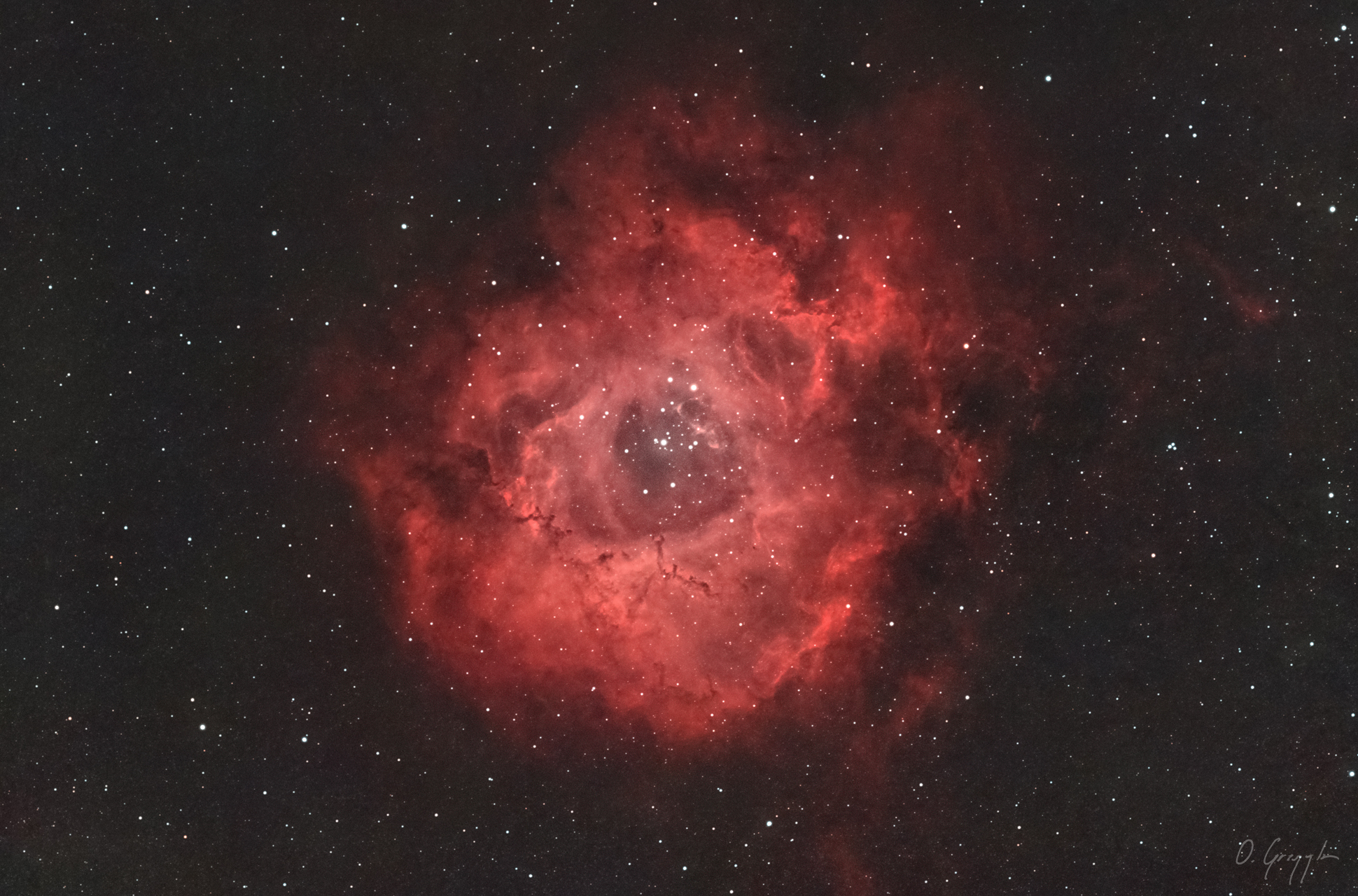
Rosette Nebula
A spectacular cosmic rose blooming in the constellation Monoceros, roughly 5,000 light-years from Earth. A sprawling stellar nursery where brilliant newborn stars illuminate a colossal cloud of glowing crimson gas.
A Cosmic Rose in the Unicorn
The Rosette Nebula (cataloged as Caldwell 49, with its sub-regions designated NGC 2237 through NGC 2246) is one of the most magnificent star-forming complexes in the northern winter sky. It resides within the boundaries of the faint constellation Monoceros (the Unicorn), just east of Orion, roughly 5,000 light-years away from Earth.
While its visual symmetry evokes a blooming cosmic flower, the nebula is actually a vast, turbulent molecular nursery spanning over 130 light-years across. The total mass of dust and gas within this complex exceeds 10,000 solar masses, and the ancient light collected in this frame began its journey across space around the time Egypt's earliest pyramids were being raised.
Stellar Offspring Sculpting Their Origin
The iconic hollowed silhouette of the Rosette is the direct result of violent stellar evolution. Anchored in the center of the nebula lies NGC 2244, a luminous open cluster that condensed directly from this natal cloud merely a few million years ago.
The cluster's most massive, blistering O- and B-type stars unleash torrential stellar winds alongside extreme ultraviolet flux. These stellar winds function like an interstellar blowtorch, clearing away the low-density gas from the core and carving out a central bubble roughly 30 light-years wide.
The vivid crimson hues saturating the frame are produced by ionized hydrogen (the characteristic H-alpha emission line at 656.3 nm), continuously energized by the relentless ultraviolet bombardment from the central stars.
Dark Pillars and Bok Globules
A closer inspection of the nebular anatomy reveals intricate ribbons, tendrils, and sharp dark pillars pointing radially toward the central cluster. These silhouettes consist of cold molecular gas and silicates that are dense enough to resist the outward pressure of the stellar winds.
Known as elephant trunks and Bok globules, these dense dust knots undergo continuous external ablation while their interiors are dynamically compressed. Deep inside these opaque pockets, gravitational collapse is actively taking place, birthing the next generation of protostars and planetary disks. In several million years, the cluster's relentless radiation will erode the surrounding veil entirely, leaving behind only the sparkling star cluster drifting naked across the Milky Way.
- OBJECT
- Caldwell 49 (NGC 2237)
- CAPTURE DATE
- March 19, 2026
- TELESCOPE / OPTICS
- Askar 60F
- CAMERA / SENSOR
- Canon EOS 700D (Mod)
- MOUNT
- Sky-Watcher EQ3-2 Pro
- BORTLE SCALE
- Class 6
- ANGULAR SIZE VS MOON
- MOON: 0.5°1.3° (~2.6×)