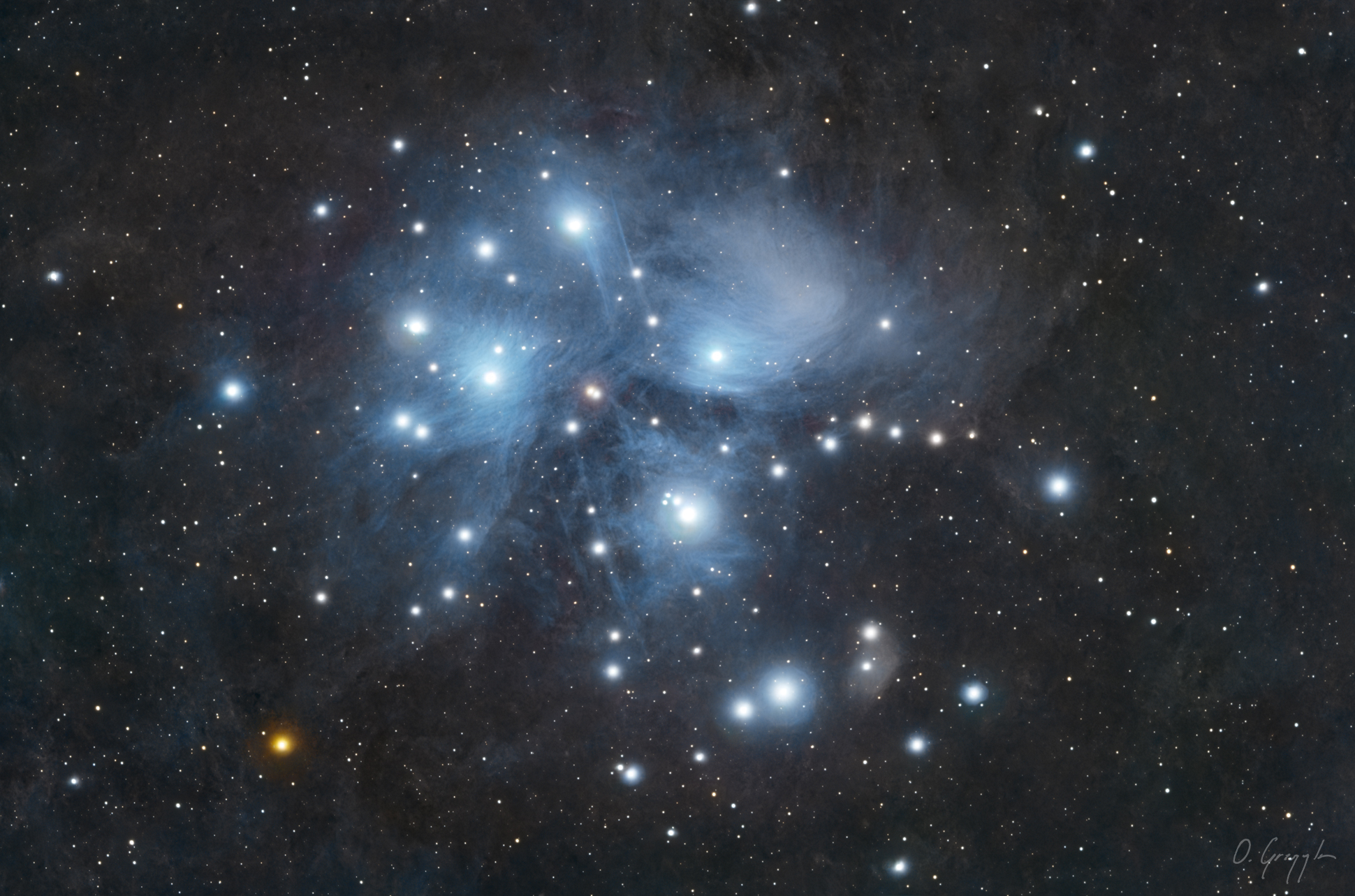
The Pleiades
A young open star cluster in the constellation Taurus, located just 444 light-years from Earth. Enveloped in a striking veil of azure reflection nebulosity, it remains one of the most iconic gems of the winter sky.
Diamonds in an Azure Veil
The Pleiades (M45), colloquially known as the Seven Sisters, are arguably the most recognizable star cluster in the night sky. Situated a mere 444 light-years from the Solar System, they are practically our next-door neighbors on a galactic scale.
Looking toward the constellation Taurus with the naked eye reveals a tight group of six or seven shimmering pinpricks, frequently mistaken by beginners for a miniature dipper. Long camera exposures, however, unveil an entirely different reality: the space between the stars is filled with a dense, intricate cloud of dust illuminated by a sapphire glow.
A Cosmic Coincidence: Where Did the Dust Come From?
For decades, astronomers assumed the nebulosity visible in photographs was the remnant of a stellar nursery – the primordial gas cloud from which the Pleiades were born. Closer investigations revealed a fascinating truth, however: it is pure coincidence.
The Pleiades are approximately 100 million years old and blew away their natal gas into deep space long ago. Today, they are hurtling through the Milky Way at tens of kilometers per second and have only just recently crossed paths with an entirely unrelated, passing interstellar dust cloud.
What we are witnessing is a classic reflection nebula. Particles of carbon, silicates, and ice do not emit light of their own (unlike the ionized gas in emission nebulae), but rather reflect and scatter the radiation from the cluster's hottest stars. This is driven by the exact same physical mechanism – Rayleigh scattering – responsible for Earth's blue daytime sky.
More Than Seven Sisters
While the moniker suggests a modest family, this gravitationally bound ensemble actually counts more than 1,000 confirmed stars scattered across a sphere spanning roughly a dozen light-years. It is dominated by scorching, intensely luminous B-type blue giants. The brightest among them – Alcyone – shines through the void more than 1,000 times brighter than our Sun.
This spectacle will not last forever. In approximately 250 million years, gravitational shear from the Milky Way and encounters with massive molecular clouds will tear the cluster apart, scattering its stars across the galaxy as lone wanderers – just as happened billions of years ago to our Sun's own stellar siblings.
Field Note: I captured this image straight from my backyard on Christmas Eve, with temperatures plunging well below -20°C. The deep freeze purged virtually all moisture from the air, creating a spectacularly stable, crystalline atmosphere – ideal conditions for astrophotography. The price, however, was steep: cables turned stiff as wire rods, the mount and telescope frosted over right before my eyes, and I froze right alongside them with every minor adjustment.
- OBJECT
- M45 (Melotte 22)
- CAPTURE DATE
- December 24, 2025
- EXPOSURE TIME
- 14h 6m
- TELESCOPE / OPTICS
- Askar 60F
- CAMERA / SENSOR
- Canon EOS 700D (Mod)
- MOUNT
- Sky-Watcher EQ3-2 Pro
- BORTLE SCALE
- Class 6
- ANGULAR SIZE VS MOON
- MOON: 0.5°1.8° (~3.6×)