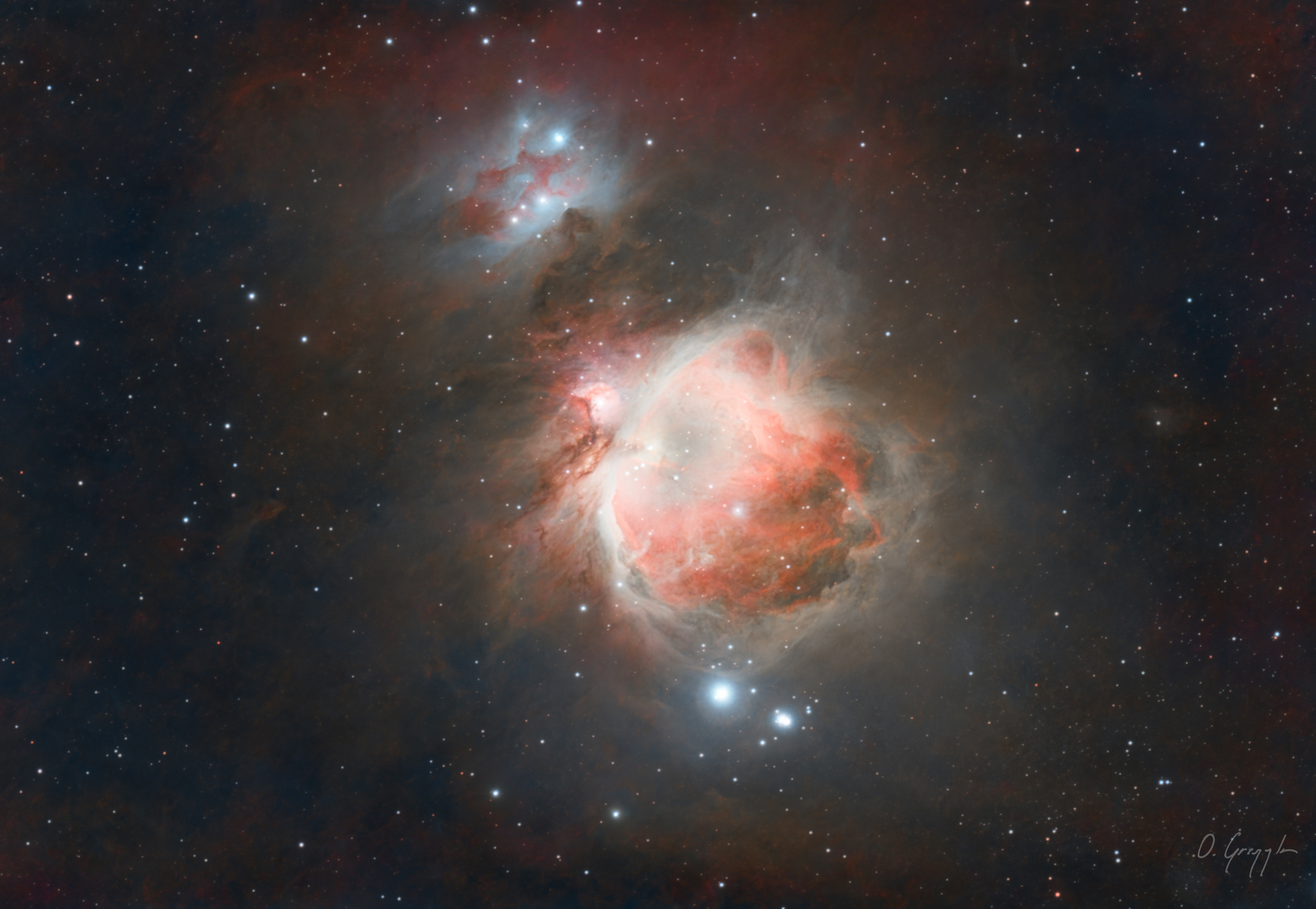
Orion Nebula
The brightest nebula of the winter sky, visible even to the naked eye within Orion's sword. A single frame capturing the glowing red and teal gas of M42, neighboring M43, and the cool blue reflection of the Running Man Nebula (NGC 1977).
A Stellar Cradle Within Reach
The Great Orion Nebula is the undisputed ruler of the winter sky and one of the most mesmerizing targets within reach of Earth-based telescopes. Situated roughly 1,344 light-years away – it is the nearest massive star-forming region to our Solar System.
While most nebulae require multi-hour exposures just to emerge in a photo, M42 shines so brightly that you can easily spot it with the naked eye. Simply look toward the constellation Orion: just beneath the iconic trio of Belt stars hangs a smaller vertical stellar cascade known as Orion's Sword. Its central point is not a single star, but rather a luminous cloud of ionized gas. While binoculars reveal it as a faint greenish-gray vapor, in the night sky it actually covers an area more than twice the size of the full Moon.
The Heart of the Beast: The Trapezium Cluster
The nebula's remarkable radiance does not come from nowhere. Tucked deep in its core lies a young open cluster whose four brightest stellar members form a distinct quadrilateral – earning them the moniker Trapezium.
These infant stars are barely a few hundred thousand years old, yet their mass and energy output are colossal. The most powerful among them, Theta-1 Orionis C, unleashes such an intense flood of ultraviolet radiation and stellar winds that it has hollowed out a gargantuan cavern inside the surrounding cloud.
This is precisely where the physics behind the nebula's iconic palette unfolds:
- The luminous core surrounding the Trapezium glows with the light of doubly ionized oxygen (O III), energized by the searing temperatures of the central stars.
- The sweeping pink wings extending outward consist of ionized hydrogen (H-alpha line), heated and pushed outward into interstellar space by expanding shockwaves.
Within this churning cosmic crucible, astronomers using the Hubble and James Webb space telescopes have uncovered hundreds of proplyds – dense protoplanetary disks cocooning newborn stars. Around many of them, the foundational seeds of future solar systems are already taking shape.
- OBJECT
- M42 (NGC 1976)
- CAPTURE DATE
- January 19, 2026
- TELESCOPE / OPTICS
- Askar 60F
- CAMERA / SENSOR
- Canon EOS 700D (Mod)
- MOUNT
- Sky-Watcher EQ3-2 Pro
- BORTLE SCALE
- Class 6
- ANGULAR SIZE VS MOON
- MOON: 0.5°1.1° (~2.2×)