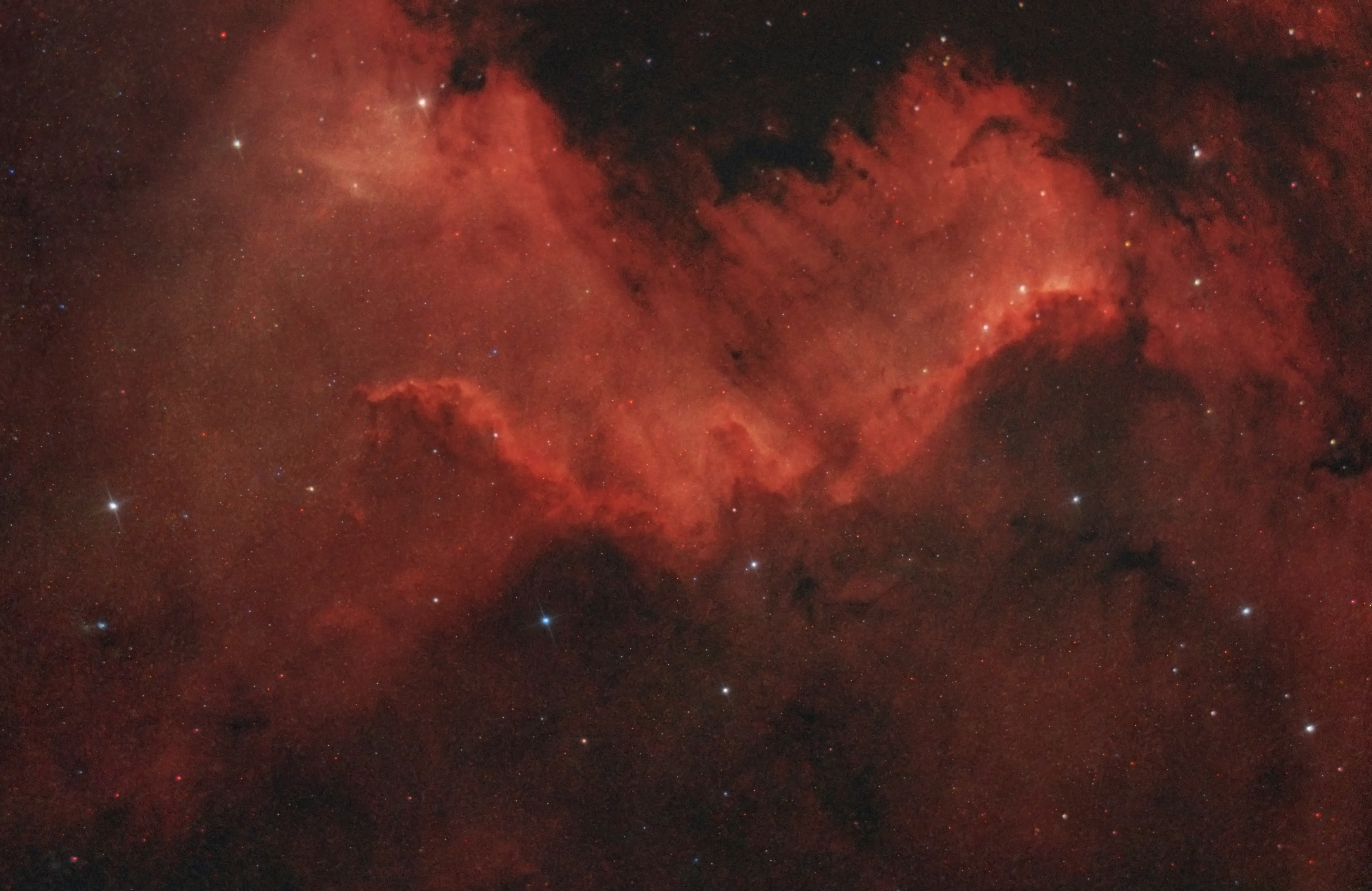
The Cygnus Wall
A dense ridge of gas and dust in the constellation Cygnus, roughly 2,600 light-years from Earth. It is the most dynamic section of the North America Nebula, where intense radiation illuminates clouds and triggers new star formation.
A Twenty Light-Year Cosmic Cliff
This frame captures the most rugged and active portion of the North America Nebula – commonly referred to as the Cygnus Wall. In wide-field views of the complex, this formation corresponds to the geographic contours of Mexico and Central America. The entire structure lies approximately 2,600 light-years away from Earth.
While it appears from our vantage point as a luminous cloud boundary, it is actually a massive ridge of interstellar matter spanning over 20 light-years in length. For scale: that is nearly five times the distance separating our Solar System from the closest stellar neighbor, Proxima Centauri.
The Hidden Sculptor and Relativistic Jets
This jagged ridge marks an active ionization shock front – a turbulent boundary where harsh ultraviolet radiation and stellar winds slam into a cold, dense molecular cloud (seen as the dark foreground dust below and to the right).
The primary powerhouse behind this glow is a massive binary star (2MASS J20555125+4352246), obscured from direct view behind thick lanes of dust. Its fierce stellar winds blast outward at millions of kilometers per hour, sweeping low-density gas into the void. Denser dust pockets resist erosion far longer, sculpting the dark pillars and sharp spires that point toward the radiation source.
This radiation pressure does not merely destroy; it also compresses. Within the Wall itself, astronomers have cataloged numerous young stellar objects, including the remarkable HH 555 – an infant protostar ejecting narrow, bipolar jets of matter that are noticeably bent by expanding stellar winds like smoke in a gale.
Cutting Through Suburban Skies with H-Alpha
Capturing these intricate hydrogen filaments under suburban skies (Bortle 6) was achieved by utilizing a narrowband H-alpha (12 nm) filter.
The filter serves as a precise bandpass tool: it eliminates virtually all artificial city light pollution, transmitting only the narrow 656.3 nm wavelength produced by energized hydrogen atoms. Paired with a 750 mm focal length reflector, the optics isolate the wall's direct topography in high relief, preserving fine details that would otherwise be lost in wide-field surveys.
- OBJECT
- Caldwell 20 (NGC 7000)
- CAPTURE DATE
- May 11, 2025
- TELESCOPE / OPTICS
- Sky-Watcher Explorer 150P
- CAMERA / SENSOR
- Canon EOS 700D (Mod)
- MOUNT
- Sky-Watcher EQ3-2 Pro
- FILTERS
- CLSHα 12nm
- BORTLE SCALE
- Class 6
- ANGULAR SIZE VS MOON
- MOON: 0.5°42′ (~1.4×)