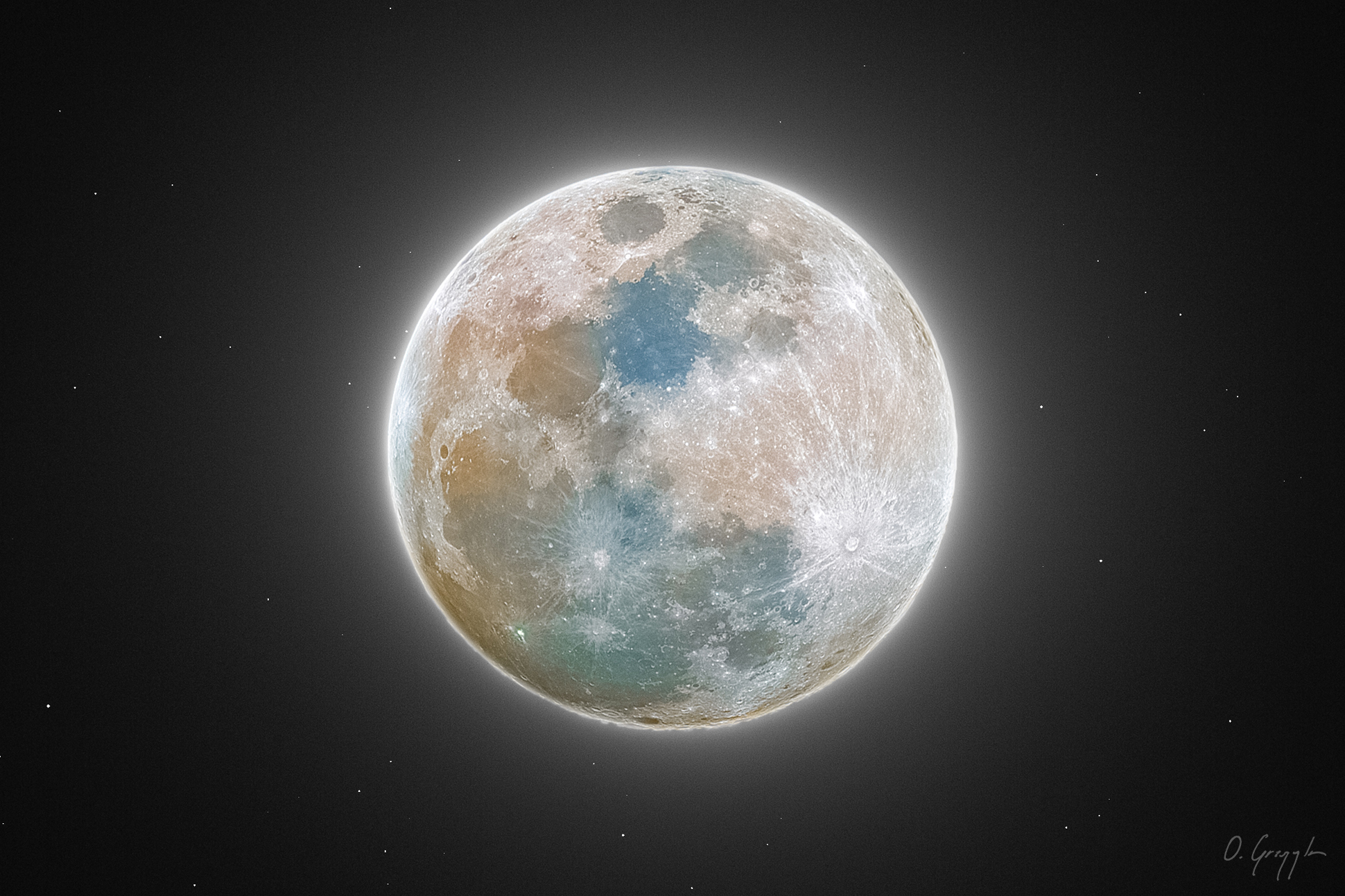
Full Moon
Our closest celestial neighbor in full glory. While appearing silvery-gray to the unaided eye, color enhancement techniques reveal its true mineral composition—rich in iron, titanium, and various minerals.
The Hidden Colors of the Silver Globe
The Moon is our closest companion in the cosmos, orbiting Earth at an average distance of roughly 384,400 kilometers. Unlike deep-sky nebulae and distant galaxies whose light journeys for thousands or millions of years, photons bouncing off the lunar surface take merely 1.3 seconds to reach the camera sensor.
From Earth's surface, the Moon appears strikingly monochromatic: bright, stark, and bone-dry gray. In reality, its surface is far from uniform. Human vision defaults to low-light rods at night, and the overwhelming brilliance of the lunar disk washes out delicate shifts in color. By capturing clean data and carefully elevating saturation, the true Mineral Moon comes to life.
The Geology Behind the Hues
The vivid palette across the disk is not artistic license; it acts as a direct chemical map of lunar regolith:
- Blues and indigo tones — mark volcanic maria enriched with titanium dioxide and ilmenite minerals. A prime example is the Sea of Tranquility (Mare Tranquillitatis), the historic landing site of Apollo 11 in 1969.
- Oranges, rust, and warm browns — indicate basaltic lavas low in titanium but richer in iron oxide and silicates.
- Bright white-blue rays — represent comparatively fresh, unweathered material excavated and sprayed across the surface by asteroid impacts. This is most prominent around the Tycho crater in the south, with vast ejecta rays spanning thousands of kilometers.
Why High Dynamic Range (HDR)?
Capturing a full moon is notoriously tricky. Sunlight strikes the visible face almost completely straight-on, eliminating the long shadows along crater walls that usually create depth and texture. The disk risks appearing flat and easily blown out.
Utilizing HDR techniques (merging multiple bracketed exposures) balances this extreme brightness range: brilliant highlands retain fine structural detail while darker basaltic basins preserve their subtle mineral variations.
- OBJECT
- Luna
- CAPTURE DATE
- January 12, 2026
- TELESCOPE / OPTICS
- Askar 60F
- CAMERA / SENSOR
- Canon EOS 700D (Mod)
- MOUNT
- Sky-Watcher EQ3-2 Pro