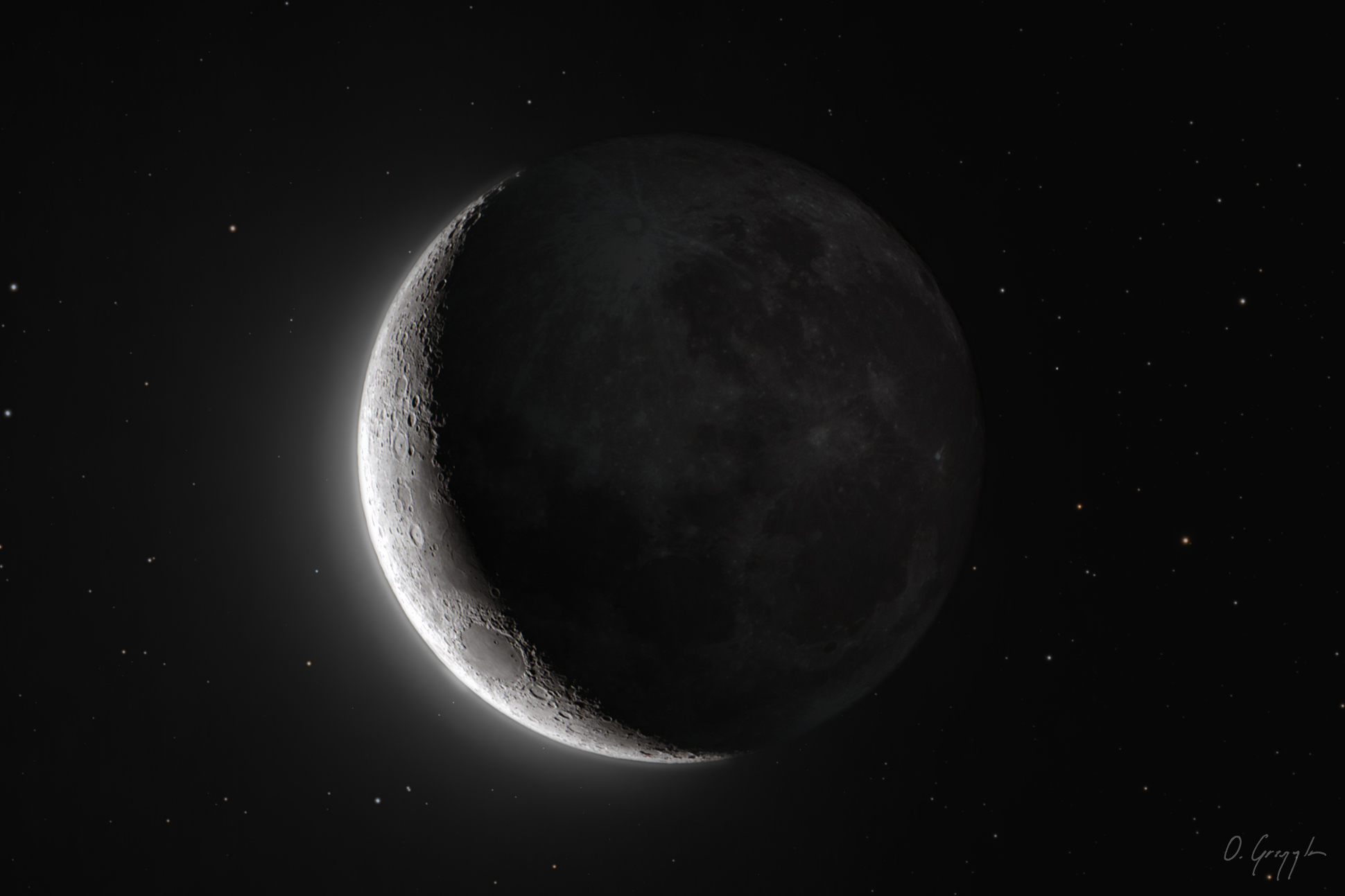
Crescent Moon
A slender crescent Moon captured in high dynamic range (HDR). The frame balances the brilliant sunlit limb with the darkened side of the disc, revealed by delicate earthshine – sunlight reflected from Earth.
Leonardo's Glow and Earthshine
The defining feature of this composition is the visibility of the Moon's unlit portion – a phenomenon known as earthshine (światło popielate).
When only a slender crescent is visible from Earth, the sunless portion of the lunar disc does not dissolve into complete darkness. Instead, it is illuminated by our own planet. To an observer standing on the Moon's dark side, Earth would appear in the lunar sky nearly "full" – enormous, brilliant, and bouncing vast amounts of sunlight across the void. That terrestrial glow strikes the lunar regolith and reflects straight back into our optics.
Leonardo da Vinci was the first to correctly deduce this optical mechanism in the early 16th century within the Codex Leicester, decades before the invention of the astronomical telescope – which is why this faint luminescence is often called Da Vinci's glow.
Topography Along the Terminator
During a full moon, the lunar surface appears washed out and two-dimensional due to direct, overhead sunlight. A slender crescent provides the exact opposite dynamic thanks to the terminator – the boundary dividing lunar day from lunar night.
Along this demarcation line, sunlight grazes the landscape at extremely shallow angles. This casts long, dramatic shadows across crater floors, rim walls, and mountain peaks. The terminator transforms the Moon into a tactile, sculpted sphere, revealing the rugged scale of ancient impacts and volcanic formations in striking relief.
The HDR Challenge: Bridging Extreme Contrasts
Technically, balancing this frame is one of the steepest challenges in lunar photography. The brightness difference between the sunlit crescent and the shadowed side illuminated solely by Earth is immense – spanning well over a dozen stops of dynamic range.
A single camera exposure cannot capture both realms simultaneously:
- A fast exposure renders the sunlit rim with crisp textural clarity, but leaves the night side pitch black.
- A long exposure reveals the subtle maria and crater rims within the earthshine, but completely blows out the crescent into an overexposed white glare.
Bridging these two extremes into a natural, balanced portrait required a high dynamic range (HDR) approach. By stacking bracketed frames across a wide span of shutter speeds, the final image preserves fine crater detail along the razor-sharp sunlit limb while simultaneously teasing out the faint geography of the dark side.
- OBJECT
- Luna
- CAPTURE DATE
- May 23, 2026
- TELESCOPE / OPTICS
- Askar 60F
- CAMERA / SENSOR
- Canon EOS 700D (Mod)
- MOUNT
- Sky-Watcher EQ3-2 Pro