Solar Eclipse
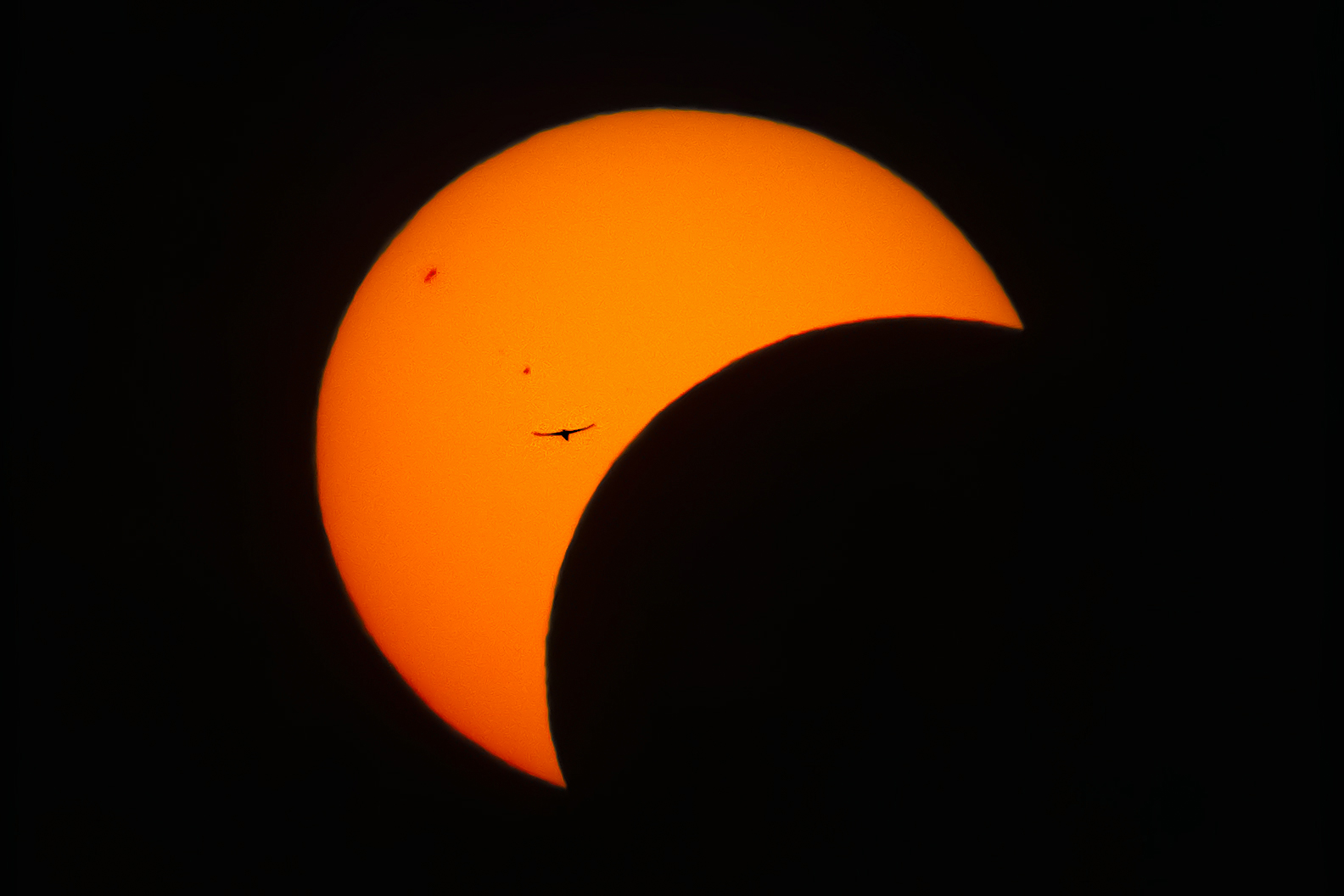
A deep partial solar eclipse from August 12, 2026, captured shortly before sunset. In a single fraction of a second, three distant worlds aligned: the Moon occluding our star, active sunspots, and the silhouette of a passing bird.
An Accidental Transit: Three Worlds Colliding
This capture is proof that in astrophotography, meticulous preparation occasionally intersects with pure serendipity. In the tiny fraction of a second when the shutter clicked, three distinct entities at vastly different cosmic scales aligned along the optical axis:
- A bird in mid-flight – cruising merely dozens of meters above the lens, resolved as a sharp silhouette against the blinding solar photosphere.
- The Moon – an impenetrable, razor-sharp arc carving away over 80% of the Sun, stationed 384,000 kilometers away.
- The Sun and its sunspots – our anchor star blazing 150 million kilometers in the background. To the left of the bird, a distinct group of sunspots is clearly resolved – regions of concentrated magnetic activity where temperatures run hundreds of degrees cooler than the surrounding plasma.
Catching a bird transit directly across the active solar crescent without motion blur was a stroke of absolute luck enabled by high shutter speeds.
The August 12, 2026 Eclipse
The eclipse of August 12, 2026, marked one of the most anticipated European astronomical spectacles of the decade. While the path of totality swept across Greenland, Iceland, and northern Spain, Central Europe experienced a dramatic sunset event.
The eclipse commenced in the late afternoon, with peak obscuration occurring as the Sun dipped low toward the western horizon. Rather than an overhead daylight show, observers witnessed a razor-sharp, ember-like crescent slowly descending into the densest layers of Earth's atmosphere.
Why the Sun Flattens and Turns Crimson on Video
The accompanying timelapse highlights two compelling optical phenomena governed by atmospheric physics:
- Vertical flattening (atmospheric refraction) – Earth's atmosphere functions as a vast cylindrical lens. The lower a celestial body sits, the more aggressively dense air bends its light upward. Because the bottom limb of the solar disk is closer to the horizon than the top limb, it experiences significantly greater upward displacement. This differential refraction amounts to roughly half a degree – matching the angular diameter of the Sun itself. As a consequence, the circular disk is compressed into an oval.
- Dimming and spectral reddening (atmospheric extinction) – as the Sun approaches the horizon, its light travels through up to ten times more atmospheric mass than at zenith. Gas molecules, water vapor, and aerosols scatter short wavelengths (blue and green) via Rayleigh and Mie scattering, leaving only long red and amber wavelengths to reach the sensor. The flux drops dramatically, painting the final stages of the eclipse in deep, ominous crimson.
- OBJECT
- Sol
- CAPTURE DATE
- August 12, 2026
- TELESCOPE / OPTICS
- Askar 60F
- CAMERA / SENSOR
- Canon EOS 700D (Mod)
- MOUNT
- Sky-Watcher EQ3-2 Pro
- FILTERS
- ND5 Solar Film