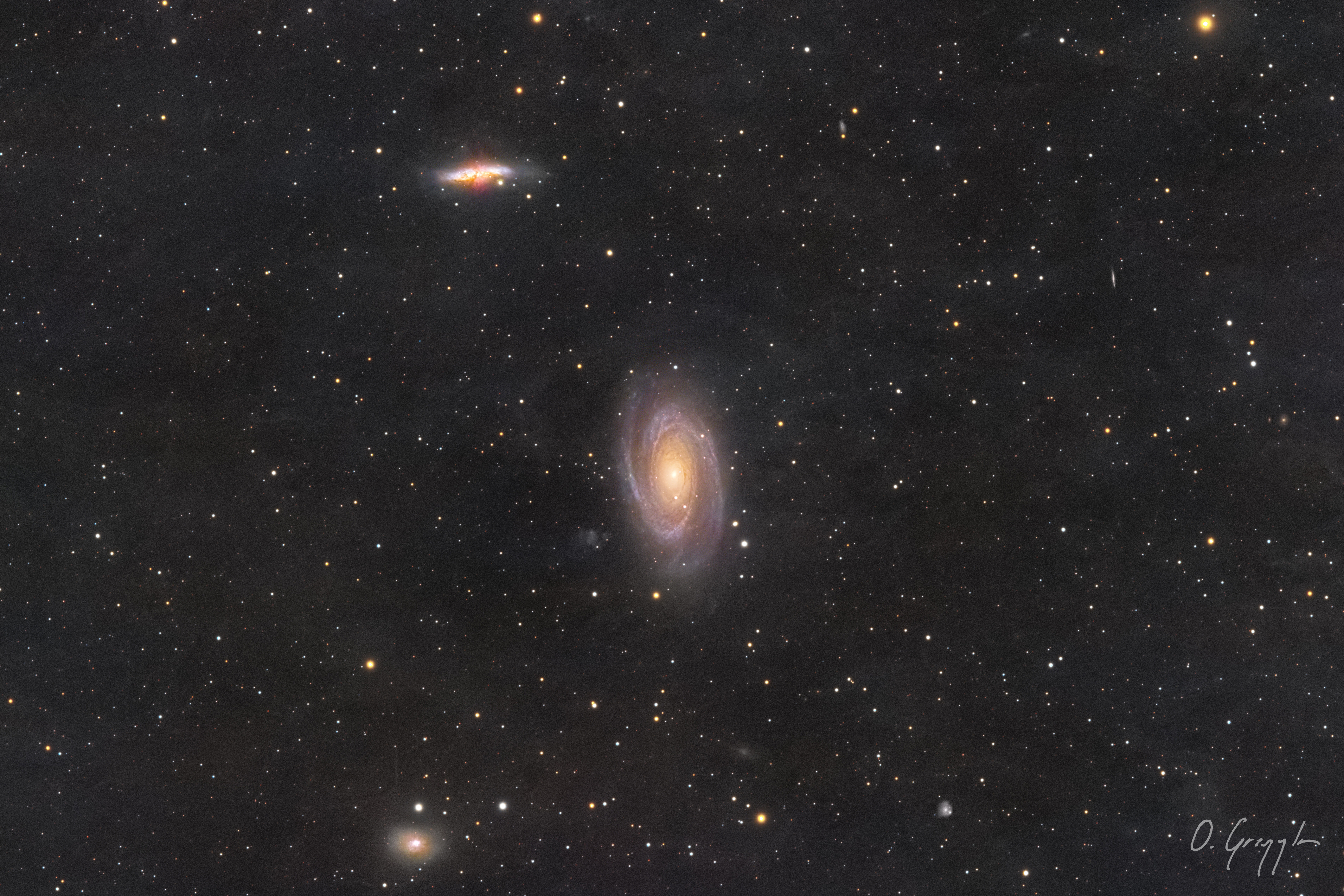
Bode's & Cigar Galaxies
A dramatic interacting galactic pair in Ursa Major, located approximately 12 million light-years away. The serene, grand-design spiral M81 contrasts sharply with the violently active starburst galaxy M82.
A Cosmic Spectacle in Ursa Major
High in the northern sky, within the constellation Ursa Major, lies one of the most photogenic deep-sky duos: Bode’s Galaxy (M81) and the Cigar Galaxy (M82). They are separated from us by a distance of roughly 12 million light-years.
Although they share the same frame, they represent two radically different galactic worlds.
M81: The Serene Giant of Spiral Architecture
Bode’s Galaxy is a textbook example of a grand-design spiral galaxy (grand design spiral). With a mass comparable to the Milky Way, its architecture exhibits breathtaking symmetry. Winding around a luminous, compact core—harboring a supermassive black hole with a mass of 70 million suns—are two prominent spiral arms, densely traced by dark dust lanes and luminous clusters of young, blue stars.
M82: A Starburst Factory Ablaze
A mere 150,000 light-years away—virtually next door on a cosmic scale—sits M82. Due to its edge-on orientation from our vantage point and slender silhouette, it earned the moniker of the "Cigar Galaxy."
Unlike its tranquil neighbor, M82 is a starburst galaxy (starburst galaxy). It resembles a cosmic proving ground: star-forming processes here churn at ten times the rate of the entire Milky Way. Within its central core, thousands of massive stars are born and die in cataclysmic supernova explosions. These violent events generate a galactic superwind that hurls massive plumes of ionized hydrogen into intergalactic space at millions of kilometers per hour—visible in deep exposures as dramatic, perpendicular red filaments bursting over 10,000 light-years outward from the galactic disk.
Gravitational Embrace of Titans
The chaotic, present-day morphology of M82 is the direct consequence of a close encounter with M81. Several hundred million years ago, the two galaxies passed each other in perilously close proximity. The tremendous tidal forces of the larger Bode’s Galaxy compressed M82's gas reserves, triggering an avalanche of star formation that persists to this day. This gravitational embrace will tighten over time—in several billion years, both galaxies will ultimately merge into a single entity.
If you look closely at the background, you will notice countless tiny, fuzzy circular smudges and faint, elongated "streaks"—these are neither sensor artifacts nor optical defects, but distant background galaxies scattered millions of light-years behind the main pair. Notice also the cosmic background itself: it is far from uniformly smooth. This subtle, mottled, and undulating texture is the IFN (Integrated Flux Nebula) slowly emerging from the dark—ghostly clouds of gas and dust suspended high in our Milky Way's halo, illuminated solely by the collective glow of our galaxy's stars, which reveal themselves only through very long exposures beneath pristine, dark skies.
- OBJECT
- M81 (NGC 3031) & M82 (NGC 3034)
- CAPTURE DATE
- January 19, 2026
- TELESCOPE / OPTICS
- Askar 60F
- CAMERA / SENSOR
- Canon EOS 700D (Mod)
- MOUNT
- Sky-Watcher EQ3-2 Pro
- BORTLE SCALE
- Class 6
- ANGULAR SIZE VS MOON
- MOON: 0.5°27′ (~0.9×)