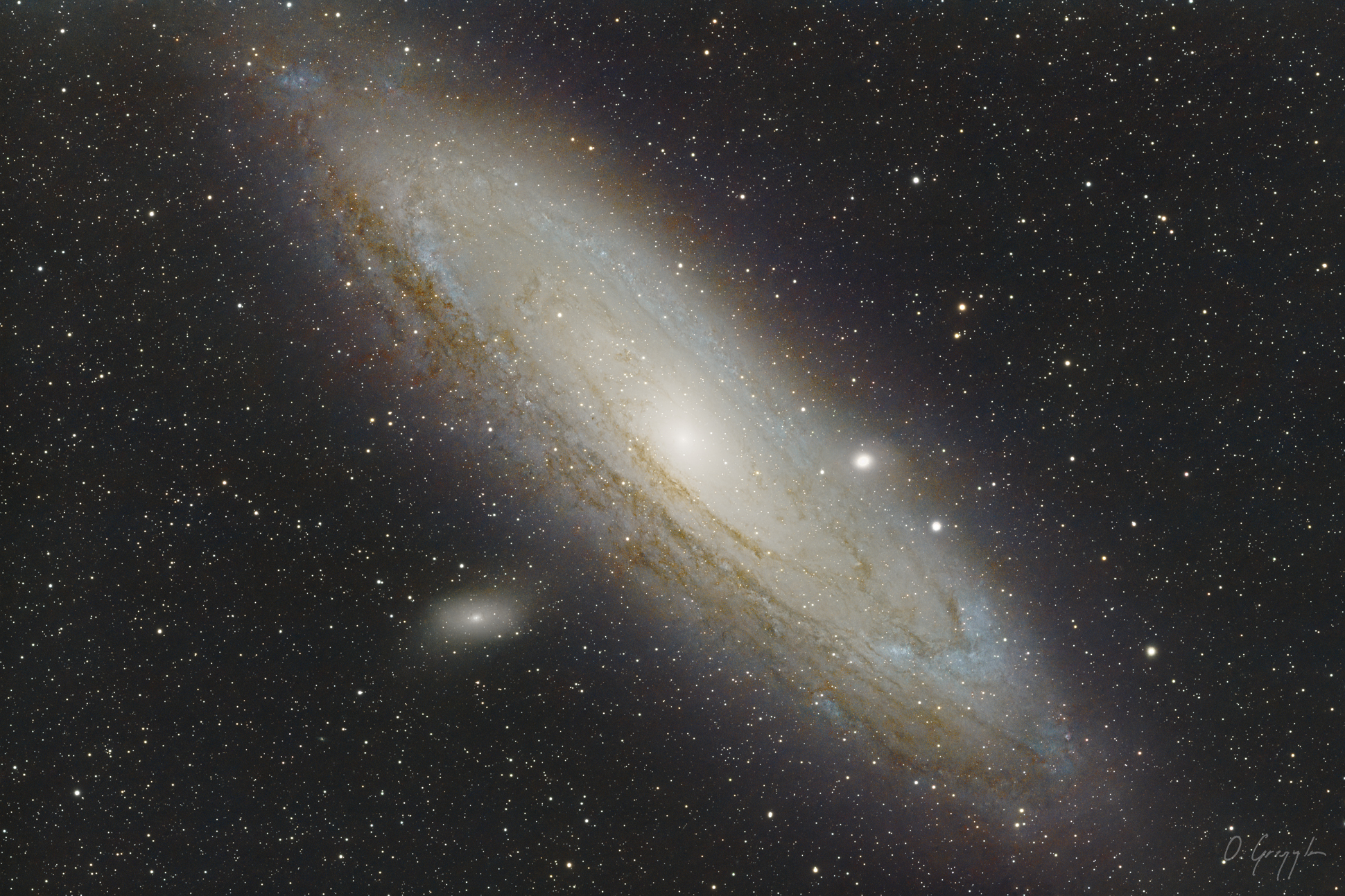
Andromeda Galaxy
A massive spiral galaxy in the constellation Andromeda, located approximately 2.5 million light-years from Earth. It is the closest major galaxy to the Milky Way and the most distant object visible to the naked eye.
A Giant on a Collision Course
The Andromeda Galaxy (M31) is the most distant object in the cosmos visible to the naked eye – separated from us by an unimaginable distance of about 2.5 million light-years. This means the photons captured by my camera's sensor embarked on their journey in an epoch when the earliest human ancestors were first walking the Earth.
Looking up at the night sky without a telescope, we only see its tight, bright core resembling a hazy star. Yet if human eyes were sensitive enough to perceive its full spiral arms and outer halo, Andromeda would dominate the nocturnal landscape – occupying an area in the sky more than six times larger than the full Moon.
Collision of Titans
While most galaxies in the universe are fleeing from us due to the expansion of spacetime, we share a mutual gravitational pull with Andromeda. It is hurtling toward the Milky Way at a breakneck speed of approximately 110 kilometers per second (nearly 400,000 km/h).
In about 4 to 4.5 billion years, a spectacular collision between both colossi will occur. However, this does not mean a Hollywood-style cosmic catastrophe – the distances between stars are so immense that a direct collision between two celestial bodies is practically impossible. Instead, the galaxies will pass through one another and merge into a single giant elliptical galaxy, jokingly dubbed by astronomers as Milkdromeda.
Cosmic Entourage: What Are Satellite Galaxies?
A retinue of smaller systems orbits Andromeda. A satellite galaxy functions much like the Moon orbiting the Earth – it is a smaller collection of stars, gas, and dark matter trapped within the deep gravitational well of a larger host.
Two of them clearly stand out within the frame:
- M32 (NGC 221) – a compact, bright smudge right along the upper edge of the main disk. It is a dwarf galaxy that was likely much larger in the past, but through close gravitational encounters, Andromeda literally "stripped" away its spiral arms and outer stars.
- M110 (NGC 205) – situated on the left side of the frame, a more elliptical, diffuse, and serene dwarf galaxy suspended above the halo. Unlike M32, it still retains trace amounts of dust and exhibits signs of recent star formation.
M32 and M110 are merely the brightest representatives. In reality, at least several dozen dwarf satellite galaxies orbit M31 (nearly 35 have been cataloged so far, and simulations suggest the existence of hundreds of smaller, unseen structures). Furthermore, Andromeda is a ruthless predator – in its outer halo, astronomers have discovered gigantic "stellar streams," the remnants of smaller systems that M31 tore apart and swallowed over billions of years.
- OBJECT
- M31 (NGC 224)
- CAPTURE DATE
- October 3, 2026
- EXPOSURE TIME
- 2h 7m (170 × 45s)
- TELESCOPE / OPTICS
- Askar 60F
- CAMERA / SENSOR
- Canon EOS 700D (Mod)
- MOUNT
- Sky-Watcher EQ3-2 Pro
- BORTLE SCALE
- Class 4
- ANGULAR SIZE VS MOON
- MOON: 0.5°3.2° (~6.4×)